Overview
As global demand for eco-friendly packaging continues to rise, bagasse—the fibrous by-product of sugarcane processing—has quickly become one of the most important alternatives to plastic, foam, and traditional paper-based materials. Once treated as a low-value waste product, sugarcane bagasse is now a key raw material driving the shift toward sustainable, compostable food packaging.
This article explores the science behind bagasse, its global supply chain, and how it is transformed into high-performance food packaging products.
What Is Bagasse?
Bagasse is the dry, pulpy residue left after sugarcane stalks are crushed to extract juice.
Chemical Composition of Bagasse
Scientifically, bagasse is composed of:
- 40–60% cellulose (strength and rigidity)
- 20–30% hemicellulose (flexibility and bonding)
- ~20% lignin (natural binder and heat resistance)
This unique combination allows bagasse to be molded into durable, smooth, and food-safe packaging without the need for synthetic binders or chemical reinforcements. Cellulose provides strength, hemicellulose contributes flexibility, and lignin acts as a natural binder—reducing the need for artificial glues or chemical reinforcements.
Bagasse is mostly found in countries which are producing large quantities of sugar, for example, Brazil, Vietnam, China, or Thailand. These nations produce millions of tons of bagasse annually, providing a stable, affordable raw material supply for manufacturers of sustainable food packaging.
Why Bagasse Is Ideal for Food Packaging
The rapid growth of bagasse packaging is driven by its functional and environmental advantages:
1. Heat & Oil Resistance
Bagasse can withstand temperatures up to 120°C, making it ideal for hot meals, soups, and oily foods.
2. Strong Yet Lightweight
High cellulose content provides strength without added weight.
3. Fully Compostable
Bagasse naturally decomposes within 45–90 days, depending on composting conditions—far faster than plastic or Styrofoam.
4. Zero Deforestation
Because bagasse is a sugarcane by-product, it does not require cutting trees and helps upcycle agricultural waste.
How Bagasse Food Packaging Is Made (Step-by-Step)
Transforming sugarcane residue into food-grade packaging requires a combination of pulping, molding, and precision engineering. Below is the full production workflow:
1. Collection
Bagasse is collected directly from sugar mills after juice extraction.
2. Cleaning & Depithing
Raw bagasse contains long fibers and soft pith (~30%).
Depithing removes impurities and improves: product strength, surface smoothness, pulp quality and reduced chemical usage
3. Pulping
Fibers are processed using mechanical, chemical, or chemi-mechanical pulping to create a uniform pulp slurry.
4. Refining
The pulp is refined to optimize fiber length, bonding quality, and texture.
5. Thermoforming (Molding)
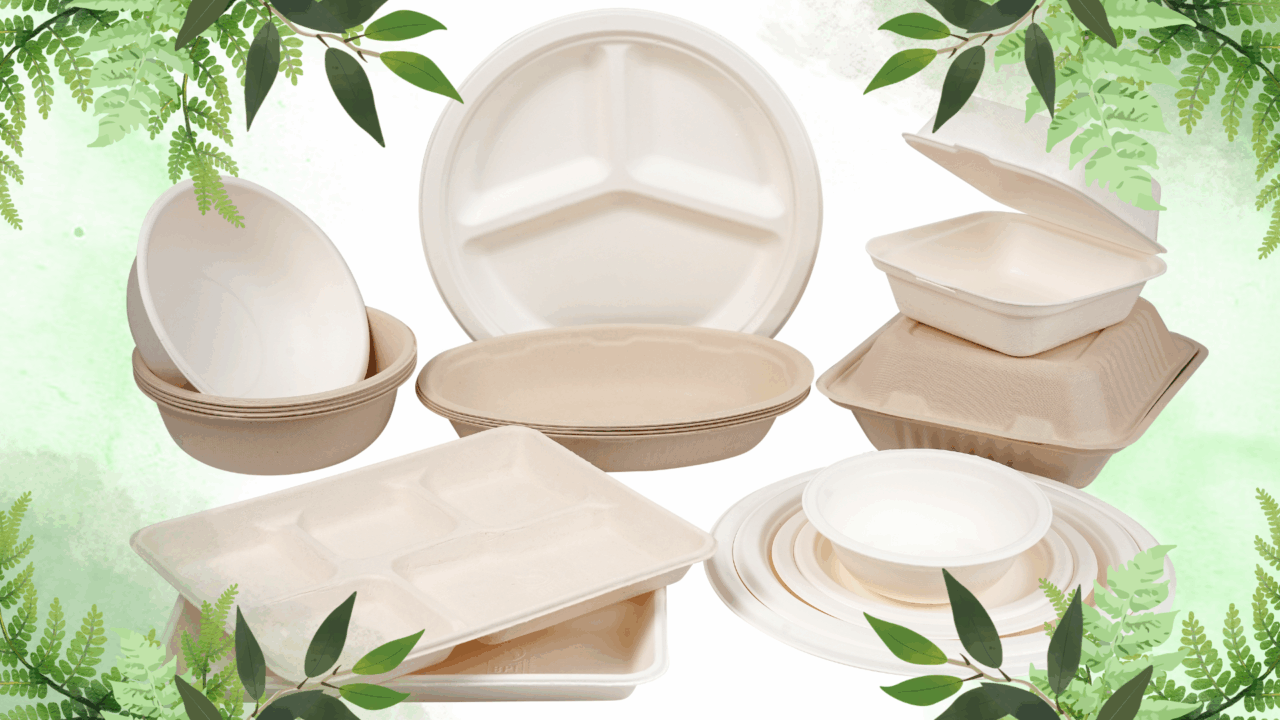
The pulp mixture is poured into precision molds shaped like: plate, bowl, tray, clamshell box,…
High heat (160–200°C) and pressure shape the final product.
6. Drying & Hot-Press Finishing
A second hot-press step enhances: structural rigidity, smoothness
, water and oil resistance and dimensional accuracy
7. Trimming & Quality Control
Edges are trimmed, and products undergo: strength testing, leakage and oil resistance tests, hygiene inspections
8. Sterilization & Packaging
Finished items are UV-sterilized and packed in hygienic cartons for distribution to restaurants, retailers, and food service industries.
Conclusion
Bagasse is more than an eco-friendly alternative—it is a scientifically proven, economically scalable, and environmentally responsible material for the future of sustainable food packaging. With strong global supply, excellent material properties, and increasing consumer demand for green products, bagasse will continue to lead the shift toward a circular, low-waste packaging economy.
If your business is exploring natural, compostable, and high-performance packaging solutions, bagasse is one of the most powerful options available today.
💬 Get in Touch
If you’re interested in our products or want to learn more about sustainable wooden packaging, feel free to reach out! I’ll be happy to assist you with any inquiries
Ms. Quinn – Sales Executive
📧 Email: contact@kego.com.vn
📞 Mobile: (+84) 986 615 346
KEGO COMPANY LIMITED
🏢 Room 603, Kim Anh Building, Lane 78, Duy Tan Street, Cau Giay District, Hanoi, Vietnam
☎ Office: (+84 24) 3222 2333 | Fax: (+84 24) 3782 1616
🌐 www.kego.com.vn